
Search Utah Traffic Court Records
Utah traffic court records are public documents created when violations are filed in justice courts and district courts across the state's 29 counties. You can search these records online through official court portals, request copies by mail, or visit a court clerk in person. This guide covers how to find Utah traffic court records, pay traffic citations, look up case status, and access driving history from the key state and local resources available to the public.
Utah Traffic Court Records Quick Facts
Utah Traffic Court System Overview
Utah's traffic cases are handled primarily by justice courts operating in cities and counties across the state. Under Utah Code § 78A-7-106, justice courts have jurisdiction over Class B and C misdemeanors, traffic infractions, and violations of local ordinances within their territory. In Fiscal Year 2024, justice courts across Utah managed roughly 424,000 total filings, and approximately 349,000 of those were traffic and parking cases. That makes traffic the single largest category of cases handled by Utah's courts.
The Utah State Courts system at utcourts.gov provides centralized administration and online access tools for all courts statewide. District courts handle more serious traffic offenses that rise to the level of Class A misdemeanors or felonies, along with appeals from justice court decisions. Each of Utah's 29 counties has at least one justice court or district court division. Many larger cities also run their own municipal justice courts, which means your traffic case may be in a county court or a city court depending on where the violation occurred.
The state describes its mission as providing "an open, fair, efficient, and independent system for the advancement of justice." For traffic matters, that means giving the public several ways to look up case information, pay fines, and request records without having to appear in person every step of the way.
How to Search Utah Traffic Court Records Online
The main online tool for accessing Utah traffic court records is the XChange system. XChange is the state's primary database for district and justice court records. To use it, you create a subscriber account and pay either $30 per month or $240 per year. Once you have access, you can search by case number, party name, citation number, or attorney name. The system provides case summaries, dockets, and some document images for disposed traffic cases going back to July 1, 2011.
For individuals tracking a single case, the MyCase portal is free and does not require a subscription. MyCase lets you view your next court date, see a history of your case, access public documents filed to the case, and make payments online. You need your case number and a valid email address to register. It covers both district court and justice court cases across Utah.
The Utah Courts XChange portal shown above provides online access to traffic court case dockets and records across all Utah justice courts and district courts.
You can also inspect traffic court records for free in person at courthouse locations. Public access terminals are available at many Utah courthouses during business hours. Under Utah Code § 63G-2-201(1), every person has the right to inspect public records free of charge. Copy fees are typically $0.25 per page for standard copies. Certified copies cost more and must be ordered through the court clerk's office. Contact the specific court where your case was filed for hours and any requirements before visiting.
Utah Traffic Violation Classifications
Utah law divides traffic offenses into three main groups: infractions, misdemeanors, and felonies. Knowing which type applies to your case affects the court that hears it, the potential penalties, and how the record is retained. Infractions are the least serious category. They carry no jail time and fines up to $750. Running a red light, speeding moderately, and improper parking are common infractions. These cases are handled in justice courts and resolved by paying the fine or appearing before a judge.
Misdemeanor traffic offenses are crimes. Class C misdemeanors carry a maximum of 90 days in jail and up to $750 in fines. Class B misdemeanors can result in up to six months in jail and $1,000 in fines. Class A misdemeanors are the most serious misdemeanor level, punishable by up to one year in jail and $2,500 in fines. DUI first offenses, reckless driving, and driving on a revoked license often fall into misdemeanor categories in Utah.
Felony traffic offenses carry the harshest consequences. A third DUI within six years, for example, is charged as a third-degree felony under Utah law. Third-degree felonies can result in up to five years in prison and fines up to $5,000. Felony cases go through district court rather than justice court. Records for felony traffic cases are maintained by the district court clerk and accessible through the same XChange and MyCase systems, though the retention period is longer for felony cases.
Paying and Resolving Utah Traffic Citations
Utah courts offer several ways to pay or contest a traffic citation without visiting the courthouse. The Utah Courts ePayment portal lets you pay fines online using a credit card or electronic check. You need your citation number or case number and the name on the case. District courts typically handle Utah Highway Patrol tickets, while justice courts handle violations issued by city or county officers. Make sure you are paying through the correct court portal to avoid confusion.
Deferred Traffic Prosecution is an option for some Utah drivers who want to avoid a conviction on their record. Through the deferred prosecution program, qualifying cases can be deferred for a period of time, and if no new violations occur, the case may be dismissed. You need your case number, the court location where the citation was filed, and a valid email address to register through MyCase. CDL holders do not qualify for deferred prosecution or Plea in Abeyance in Utah. Contact your specific court to confirm whether your case qualifies.
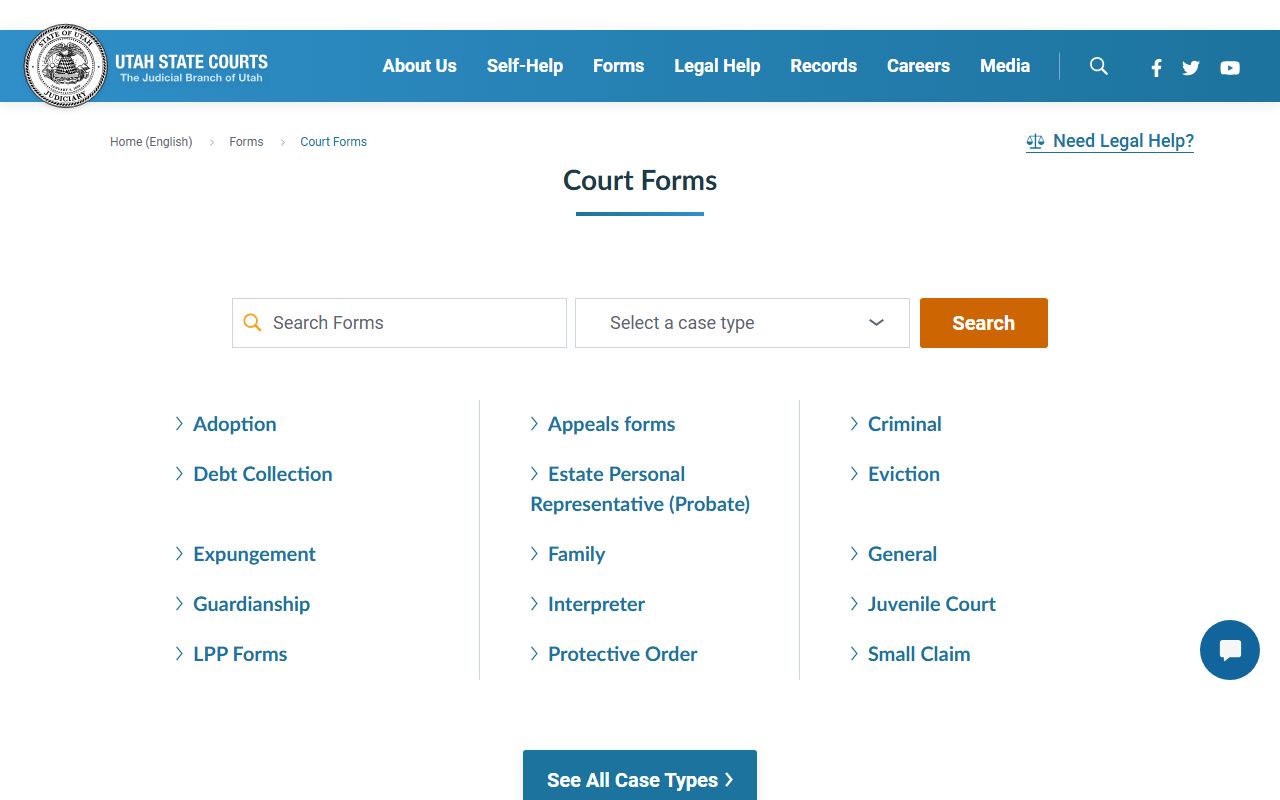
The Utah Courts forms page shown above provides downloadable forms for traffic-related proceedings including Notice of Appeal from Justice Court forms and other court filings.
Note: Missing a court date in Utah results in a warrant for arrest. Most courts allow 24 to 48 hours to contact them and reschedule before a warrant is issued, but you should act quickly if you missed an appearance.
Utah Speeding Fines and Traffic Penalties
Utah sets standard fine amounts for common traffic violations. Under Utah Code Ann. § 41-6a-601, speeding fines are tiered by how far over the limit you were going. Going 1 to 10 mph over costs $120. Going 11 to 15 mph over costs $150. Going 16 to 20 mph over is $200. Going 21 to 25 mph over is $270. Going 26 to 30 mph over costs $370. Going 31 or more mph over costs $470 plus $10 for each additional mph beyond 31.
Construction zone violations carry higher fines in Utah. The same speed tiers apply but at elevated amounts: $170 for 1 to 10 mph over, $220 for 11 to 15 mph over, $320 for 16 to 20 mph over, $470 for 21 to 25 mph over, $670 for 26 to 30 mph over, and $870 plus $20 per mph over 31 mph. These enhanced penalties apply within active construction zones where workers may be present.
Utah also uses a point system to track driving behavior. Reckless driving earns 80 points. Speeding violations add 35 to 75 points depending on how fast you were going. Failure to yield right-of-way or following too closely each add 60 points. Running a red light or stop sign adds 50 points per offense. Adults who accumulate 200 or more points within three years face a license suspension of three months to one year. Drivers under 21 face suspension at 70 points, which is a lower threshold.
Utah Motor Vehicle Records and Driving History
The Utah Driver License Division maintains driving records for every licensed driver in the state. These records include convictions for moving traffic violations and suspensions within the past three years. Alcohol and drug-related violations, suspensions, and revocations stay on the record for ten years. When a court convicts someone of a moving violation, it sends notice to the Division, which then posts the conviction to the driver's record.
The Secure Utah MVR portal allows organizations to access and monitor driver history records. The system provides Driver History Records Search covering moving violations, suspensions, and revocations, as well as Commercial Driver History Search which includes pleas in abeyance and medical certificate data. The portal also offers Driver History Monitoring, which sends notifications when a monitored record changes. Access requires a business profile and approval from the Utah Driver License Division.
Crash reports for accidents on Utah roadways are handled separately by the Department of Public Safety. Reports are searchable by date of occurrence, driver's license number, or name, and cover crashes from January 1, 2010 forward. The Utah Bureau of Criminal Identification serves as the central repository for criminal history data in Utah, including traffic offenses that qualify as misdemeanors or felonies. State archives are accessible through archives.utah.gov for older historical records.
Utah Traffic Court Records and Public Access
Traffic court records in Utah are generally public under the Government Records Access and Management Act. Utah Code § 63G-2-103 defines court records as records created, maintained, or received by a court or its political subdivisions. The public has the right to inspect these records. You do not need to be a party to the case to request access.
Some exceptions apply. Juvenile traffic records are not public. Records that are sealed by court order are not accessible to the public. Certain information within a record, such as Social Security numbers or financial account details, may be redacted from public copies. Outside those limits, traffic court records from justice courts and district courts throughout Utah are open to inspection.
The XChange subscription system at utcourts.gov/xchange provides the most comprehensive online access, including disposed records back to 2011. Free in-person access is available at courthouse public terminals during business hours. Written requests submitted to the court clerk are also accepted. Each court sets its own processing timeline, so direct contact with the court handling your case is the best starting point for records requests in Utah.
Browse Utah Traffic Court Records by County
Each county in Utah has its own justice court or district court handling traffic violations. Select a county to find court contact information, local access options, and resources for traffic records in that area.
Traffic Court Records in Major Utah Cities
Traffic violations in Utah cities are handled by the city's own justice court or the county justice court depending on where the offense occurred. Select a city to find local court information and how to access traffic court records in that area.